How it works
Every bulk supplier in the US quotes by the cubic yard. Here is how to get there from a tape measure.
Measure the bed
Length and width in feet. Round beds: multiply radius by radius by 3.14.
Set the depth
4 to 6 inches for a new garden bed, 2 to 3 inches for topdressing an existing lawn.
Get yards, bags and tons
Bulk is sold by the yard or ton; bags by the cubic foot. We give you all three.
The cubic yard formula
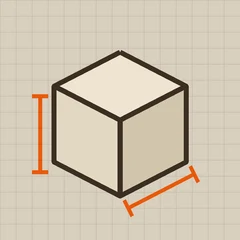
A cubic yard is a block 3 feet long, 3 feet wide and 3 feet tall, so it holds 27 cubic feet. To get cubic yards from a tape measure: multiply length by width in feet, multiply by the depth in feet (inches divided by 12), and divide the result by 27.
Example: a 12 by 10 foot patio base 4 inches deep is 12 × 10 × 0.333 = 40 cubic feet. Divided by 27, that is 1.48 cubic yards, which you would order as 1.5.
The mistake almost everyone makes is leaving the depth in inches. 12 × 10 × 4 = 480, divided by 27 is 17.8 — twelve times too much material. Always convert the depth first.
A quick rule for coverage: one cubic yard spreads over 324 square feet at 1 inch, 162 at 2 inches, 108 at 3 inches, 81 at 4 inches and 54 at 6 inches. For materials that compact, like gravel base or road base, add 5 to 10 percent. For specific materials, the gravel, mulch, topsoil and concrete calculators also give you tons, bags and weight.
A worked example: two materials for one project
A garden project might need 6 inches of soil in two 4 × 8 raised beds and 3 inches of gravel on a 3 × 20 foot path between them. The beds hold 2 × 4 × 8 × 0.5 = 32 ft³, or 1.19 cubic yards of soil. The path is 3 × 20 × 0.25 = 15 ft³, or 0.56 cubic yards of gravel. Two small volumes like these are often cheaper in bags than as two bulk deliveries; the bag table below shows how many.
Bags per cubic yard
| Bag size | Bags per cubic yard | Common for |
|---|---|---|
| 0.5 ft³ | 54 | Decorative stone, specialty soil |
| 0.75 ft³ | 36 | Topsoil (40 lb bags) |
| 1 ft³ | 27 | Potting mix, some soils |
| 1.5 ft³ | 18 | Garden soil, compost |
| 2 ft³ | 13.5 | Mulch |
| 3 ft³ | 9 | Large mulch bags |
Will it fit in your truck?
Volume and weight are different limits. A cubic yard of mulch weighs only a few hundred pounds, so a full-size pickup bed holds about 2 to 3 yards of it. A cubic yard of gravel or wet topsoil weighs roughly 2,500 to 3,000 lb, which can exceed what a half-ton pickup is rated to carry. Check the payload rating on the driver's door sticker before you load.
| Material | Approx. weight per cubic yard | Typical half-ton pickup |
|---|---|---|
| Mulch | 400–800 lb | Up to the bed volume (about 2–3 yd³) |
| Dry topsoil | About 2,200 lb | About ½ to ¾ yd³ |
| Gravel / crushed stone | About 2,600–3,000 lb | About ½ yd³ |
| Concrete (wet) | About 4,000 lb | Not a pickup job |
These are rough figures; your truck's payload rating and the material's moisture both change the answer.
Mistakes that cost money
- Leaving depth in inches. Multiply by inches and you order twelve times too much. Divide the inches by 12 first.
- Ignoring compaction. Gravel, road base and soil settle when compacted or watered. Add 5 to 15% depending on the material.
- Ordering exactly a whole number. Suppliers load in whole or half yards. If you need 1.48 yards, order 1.5, not 1.
Frequently asked questions
How do I calculate cubic yards?
Multiply length by width in feet, multiply by depth in feet (inches divided by 12), then divide by 27. A 12 by 10 foot area 4 inches deep is 40 cubic feet, or 1.48 cubic yards.
How many cubic feet are in a cubic yard?
27. A cubic yard is a cube 3 feet on each side, and 3 × 3 × 3 = 27.
How many square feet does a cubic yard cover?
324 square feet at 1 inch deep, 162 at 2 inches, 108 at 3 inches, 81 at 4 inches and 54 at 6 inches.
How many bags make a cubic yard?
13.5 bags of 2 cubic feet, 27 bags of 1 cubic foot, or 36 bags of 0.75 cubic feet.
More material calculators
Estimates are for planning only. Confirm quantities with your supplier before ordering.