How it works
Slab size and grid spacing gives you the whole mat.
Measure the slab
Length and width in feet, the same figures you used for the concrete.
Set the grid spacing
18 inches is common for a residential slab. Check your plans or local code.
Get bars and ties
Bars each way, total linear feet, and how many intersections to tie.
A mat is two directions, not one
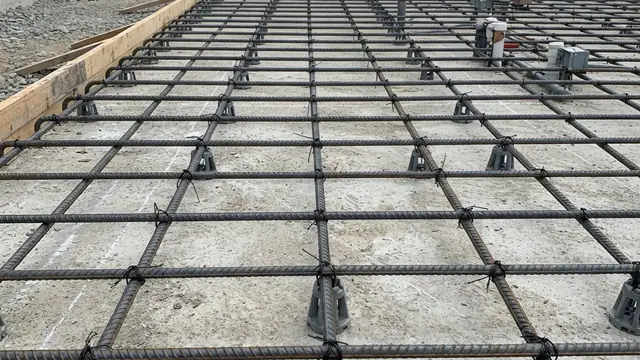
Rebar in a slab is laid as a grid, so you are buying two sets of bars at right angles. Bars running the length of the slab are spaced across its width, and bars running the width are spaced along its length. Each direction gets its own count, and the totals rarely match.
The count in each direction is the span divided by the spacing, plus one — the same off-by-one that catches people with fence posts. A 10 foot width at 18 inch spacing takes 6 spaces, which means 7 bars. Forget the plus one and you are a bar short in both directions.
The tie count is the number of intersections, which is simply one count multiplied by the other. Every intersection wants a wire tie to stop the mat shifting when the concrete goes in. They are cheap; run out mid-pour and you will regret it.
Two things this does not cover. Laps: where two bars are spliced end to end, codes typically want an overlap of around 40 bar diameters — roughly 20 inches for #4 bar — so a slab longer than your bar length needs that extra length added at every splice. And cover: the mat has to sit inside the concrete, not on the ground, usually on chairs at mid-depth. Rebar resting on dirt does nothing and will rust.
None of this replaces an engineer. For anything structural — footings, retaining walls, anything carrying load — the bar size, spacing and cover come from a design, not from a calculator.
A worked example: a 20 × 24 garage slab
For a 24 × 20 foot slab with a grid at 18 inches, the bars running the 24-foot length are spaced across the 20-foot width: 240 ÷ 18 = 13 spaces, so 14 bars. The bars running the 20-foot width are spaced along the length: 288 ÷ 18 = 16 spaces, so 17 bars. That is 14 × 24 + 17 × 20 = 676 linear feet, or 34 sticks of 20 feet, with 238 intersections to tie.
The 24-foot bars are longer than a 20-foot stick, so each one needs a splice. With a #4 bar lapped about 20 inches, the 14 splices add roughly 23 feet, which brings the order to 35 sticks. Chairs to hold the mat at mid-depth go about every 3 feet in each direction, which for this slab is around 50 to 60 chairs.
Bar sizes and laps
| Bar | Diameter | Weight per foot | Lap at 40 diameters |
|---|---|---|---|
| #3 | 3/8 in | 0.376 lb | 15 in |
| #4 | 1/2 in | 0.668 lb | 20 in |
| #5 | 5/8 in | 1.043 lb | 25 in |
| #6 | 3/4 in | 1.502 lb | 30 in |
The garage example in #4 bar weighs about 467 lb, which matters if you are hauling it yourself. Lap length is set by your local code or engineer; 40 bar diameters is a common figure, not a universal one.
Mistakes that make rebar useless
- Laying the mat on the ground. Rebar only works inside the concrete. Use chairs or concrete blocks (dobies) to hold it at the right height, usually around the middle of the slab.
- Walking it down during the pour. Workers stepping on the mat push it to the bottom. Use stiffer chairs or a grid you can step between.
- Too little cover at the edges. Keep bars about 2 to 3 inches back from the edges of the form so they are fully surrounded by concrete.
- Treating a calculator as a design. Footings, retaining walls and structural slabs need bar sizes and spacing from a design or your local code.
What it costs
A 20-foot stick of #4 rebar often sells for roughly $10 to $18 in the US, and steel prices move with the market. For the garage slab, 35 sticks come to about $350 to $630, plus ties, chairs and a tie tool.
Frequently asked questions
How much rebar for a 20x10 slab?
At 18 inch spacing, about 280 linear feet: 7 bars running the length and 14 across, or fourteen 20 foot sticks, with 98 tie intersections.
What spacing should rebar be?
18 inches is typical for a residential slab, and 12 inches for heavier loads such as a driveway. Follow your plans or local code.
Do I need to overlap rebar?
Yes, wherever two bars meet end to end. About 40 bar diameters is the usual figure — roughly 20 inches for #4 bar. That extra length is not included here.
Does rebar go on the ground?
No. It should sit at mid-depth of the slab on chairs or dobies. Rebar laid on the subgrade adds nothing and corrodes.
More material calculators
Estimates are for planning only. Confirm quantities with your supplier before ordering.