How it works
Wall size, stud spacing, and the coverage printed on the bag.
Measure the wall
Length and height in feet. Add up every wall in the room and enter the total length.
Set the stud spacing
16 inch centres is standard framing; 24 inch shows up in newer builds and garages.
Get bags and cavities
How many bags to buy, and how many cavities you are filling.
Buy for the coverage, not the square footage
Insulation is one of the few materials where the label does the work for you. Every bag prints its coverage in square feet, and that figure already accounts for the batt width and length inside. So the calculation is simply your wall area divided by that number — which is why this calculator asks you to enter it rather than guessing.
Where people go wrong is assuming the coverage is fixed. It is not. A bag of R-13 for a 2x4 wall covers far more square footage than a bag of R-21 for a 2x6, because the thicker batt takes more material per square foot. Two bags of the same brand can differ by a factor of two. Read the bag.
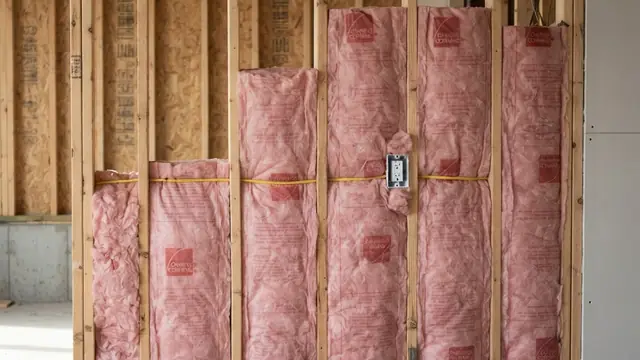
Batt width matters too, and it is not the same as your stud spacing. Batts for 16 inch centres are 15 inches wide, and batts for 24 inch centres are 23 inches. The extra inch is deliberate — it lets the batt friction-fit against the studs and stay put without stapling. Buying 23 inch batts for 16 inch framing means cutting every single one lengthwise.
The cavity count is there as a sanity check. If the number of cavities looks wrong for the wall you are standing in front of, your length or spacing is off, and the bag count will be wrong too. And do not compress insulation to make it fit: a batt squashed into a narrow bay loses much of the R-value you paid for.
A worked example: insulating a garage
Take a 24 × 30 foot garage with 8-foot walls, framed in 2x4 at 16 inches. The perimeter is 108 feet, so the walls are 864 ft². Take off a 16 × 7 foot garage door (112 ft²) and an entry door (21 ft²) and you are left with 731 ft². With 5% waste and bags that cover 40 ft², that is 20 bags. Check the coverage printed on the bag you pick; if it says 88 ft², the same wall takes 9 bags.
Common R-values by location
| Where | Framing | Typical R-value |
|---|---|---|
| Exterior wall | 2x4 | R-13 or R-15 |
| Exterior wall | 2x6 | R-19 or R-21 |
| Floor over a crawlspace or garage | 2x10 or 2x12 joists | R-25 to R-30 |
| Attic floor | Open joists | R-30 to R-60, depending on climate |
Local energy codes set the minimum for your climate zone. Colder zones need more, especially in the attic.
Air sealing comes first
Insulation slows heat moving through a wall; it does not stop air leaking through gaps. Before the batts go in, seal the holes: caulk the gaps where the bottom plate meets the floor, foam around wires and pipes that pass through the framing, and seal around window and door frames. Air sealing is cheap and often makes more difference than going up one R-value.
Mistakes that cost R-value
- Facing the vapor retarder the wrong way. In most US climates, the kraft paper facing goes toward the heated side of the wall. Very hot, humid climates can differ; follow local practice.
- Leaving gaps around outlets and pipes. Split the batt around wires and cut it to fit behind boxes instead of stuffing it in. Small gaps add up to a big loss.
- Compressing batts. A batt squeezed into a shallower cavity loses R-value. Use the batt made for your framing depth.
- Skipping protection. Fiberglass irritates skin, eyes and lungs. Wear long sleeves, gloves, eye protection and a dust mask.
Frequently asked questions
How many square feet does a bag of insulation cover?
It depends entirely on the R-value and thickness — anywhere from about 40 to over 100 ft² per bag. The figure is printed on the bag, so use that number rather than an average.
What width batt do I need?
15 inches for framing on 16 inch centres, and 23 inches for 24 inch centres. The batt is deliberately an inch wider than the gap so it friction-fits.
Does this include the attic?
Enter the attic floor as length by width and it works the same way, but attics are usually done with blown-in insulation sold by depth rather than batts.
Can I compress insulation to fit?
No. Compressing a batt into a smaller cavity reduces its R-value. Cut it to fit instead, or buy the correct width.
More material calculators
Estimates are for planning only. Confirm quantities with your supplier before ordering.